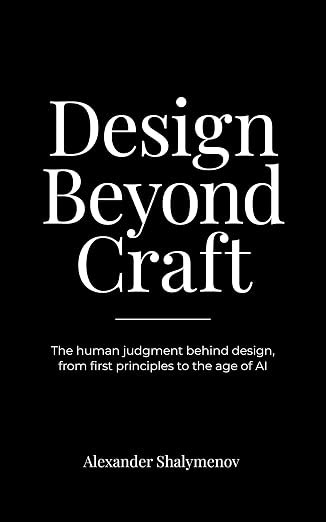
The central idea
Design is not about making things look better. It is about understanding why they should exist.
Tools can produce layouts, interfaces, illustrations, and endless variations. But the ability to make something is not the same as understanding the problem it should solve. A designer must look beyond the visible result and ask what every decision means for the person who will live with it.
Design Beyond Craft examines the distance between execution and judgment. It begins with the difference between art, craft, and design, then explores human perception, systems, context, ethics, and the choices that cannot simply be delegated to software.
Across ten parts, Alexander Shalymenov argues for design as a way of thinking: the discipline of asking better questions, making decisions with purpose, and accepting responsibility for their consequences.
Inside the book
Three questions at the heart of good design.
What problem are we solving?
Look beyond attractive surfaces and familiar solutions. Find the real need, understand the context, and let function shape the form.
What makes a system work?
Explore visual hierarchy, contrast, rhythm, modularity, scalability, and the decisions that connect an individual detail to the whole.
What should remain human?
Consider judgment, taste, ethics, curiosity, and responsibility when AI can generate more options than anyone could ever evaluate.
Read an excerpt
From the Introduction
“Ask yourself: do you want to remain only a craftsman, skilled at making things but not always understanding why they work? Or do you want to become a thinker, seeing the problem that every detail solves?”
“This book is not the truth. It is an invitation to argue. It may challenge your usual ideas about beauty, usability, and the role of the designer.”
Design Beyond Craft, Introduction
Continue reading
For those who want to move beyond the tools.
Written for designers, creative professionals, product thinkers, and anyone interested in how things work, this book invites you to question assumptions, recognize meaningful problems, and make decisions that remain valuable as technology changes.
Get the book on Amazon ↗